What Makes a Great Greek Name?
Need the perfect Greek name for a character, RPG campaign, novel, or fantasy world? Greek names have a different kind of weight to them. Even simple names often carry centuries of history, mythology, religion, or symbolism. That's why names like Athena, Leonidas, Cassandra, and Nikos still sound powerful today. A good Greek name doesn't just sound cool — it feels meaningful.
A strong Greek name usually does three things: it sounds memorable when spoken aloud, it has a meaning tied to virtue, nature, strength, wisdom, or mythology, and it matches the tone of the character or setting. Many come directly from ancient Greek root words, which is why names often feel naturally epic without trying too hard.
For example, Sophia means wisdom, Alexandros means defender of mankind, Nikephoros means bringer of victory, and Calliope means beautiful voice. That built-in symbolism is what makes Greek names so useful for storytelling, gaming, fantasy writing, and roleplay.
The sound matters too. Greek names tend to flow well because of their vowel-heavy structure and rhythmic syllables. Names like Evangelos, Ariadne, and Persephone almost sound musical when spoken aloud. If you're building fantasy characters or RPG worlds, Greek-style names also pair extremely well with our Bard, Kingdom, Witch, and Warlock generators.
How Greek Names Actually Work
Greek naming traditions go back thousands of years, but a few patterns show up again and again. Once you recognize them, Greek names become much easier to read and design.
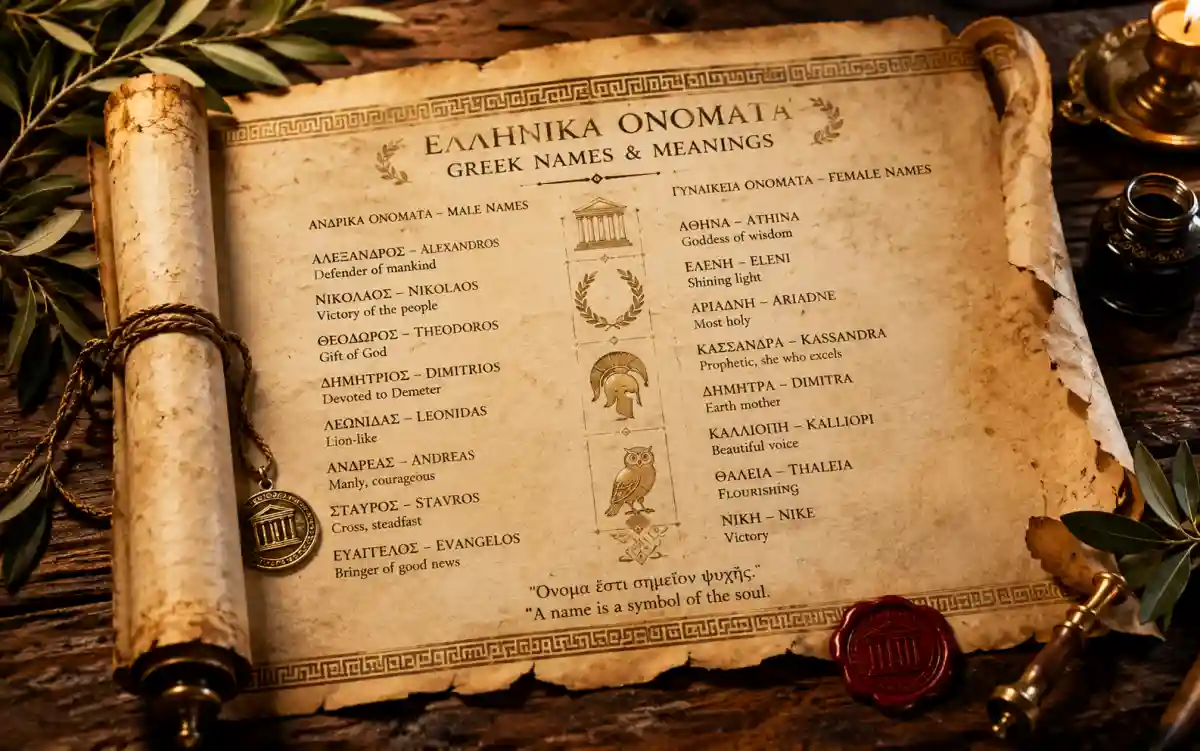
Compound names. Many traditional Greek names combine two root words. Alexandros = alexein + andros (defender of men). Nikolaos = nike + laos (victory of the people). Theodoros = theos + doron (gift of God). Demosthenes = demos + sthenos (strength of the people). Common prefixes include Theo- (god), Niko- (victory), Kalli- (beauty), Andro- (man), Demo- (people), and Philo- (love).
Ancient vs modern Greek names. Ancient Greek names tend to sound dramatic and formal — Themistocles, Andromache, Perseus, Leonidas. Modern Greek names are often shorter or evolved forms — Nikos, Yannis, Kostas, Dimitra. Both styles work depending on your setting. If you're writing ancient fantasy, mythological names feel natural. For modern Greece-inspired fiction, shorter modern forms usually sound more believable.
Greek surnames. Greek surnames often reveal ancestry or regional roots. Common endings include -opoulos (son of), -idis (descendant of), -akis (common in Crete), and -oglou (Asia Minor Greek origin). Adding a realistic surname instantly makes a character feel more grounded — for example, Leonidas is a simple fantasy hero, but Leonidas Papadopoulos feels like a real Greek identity. For building the city-states and territories these characters call home, our Kingdom Name Generator is a useful companion.
Types of Greek Names
Greek names usually fall into a few major categories, each with its own flavor and historical context.
Mythological names come directly from gods, heroes, titans, and legends — Athena, Hermes, Persephone, Achilles, Apollo. These names feel larger than life and work especially well for fantasy, RPGs, and high-powered characters.
Classical names come from philosophers, generals, poets, and historical figures — Pericles, Aspasia, Lysander, Solon, Leonidas. They sound intellectual, noble, and authoritative. These work beautifully for scholars, leaders, and characters with authority.
Byzantine and religious Greek names became popular during the Byzantine and Orthodox Christian eras — Konstantinos, Ioannis, Vasileios, Aikaterini. Many modern Western names like Constantine, John, Basil, and Catherine evolved from these forms.
Modern Greek names are shorter, more conversational, and commonly used today — Nikos, Eleni, Stavros, Dimitra, Panos. These work especially well for realistic fiction or contemporary characters.
Male Greek Names and Their Meanings
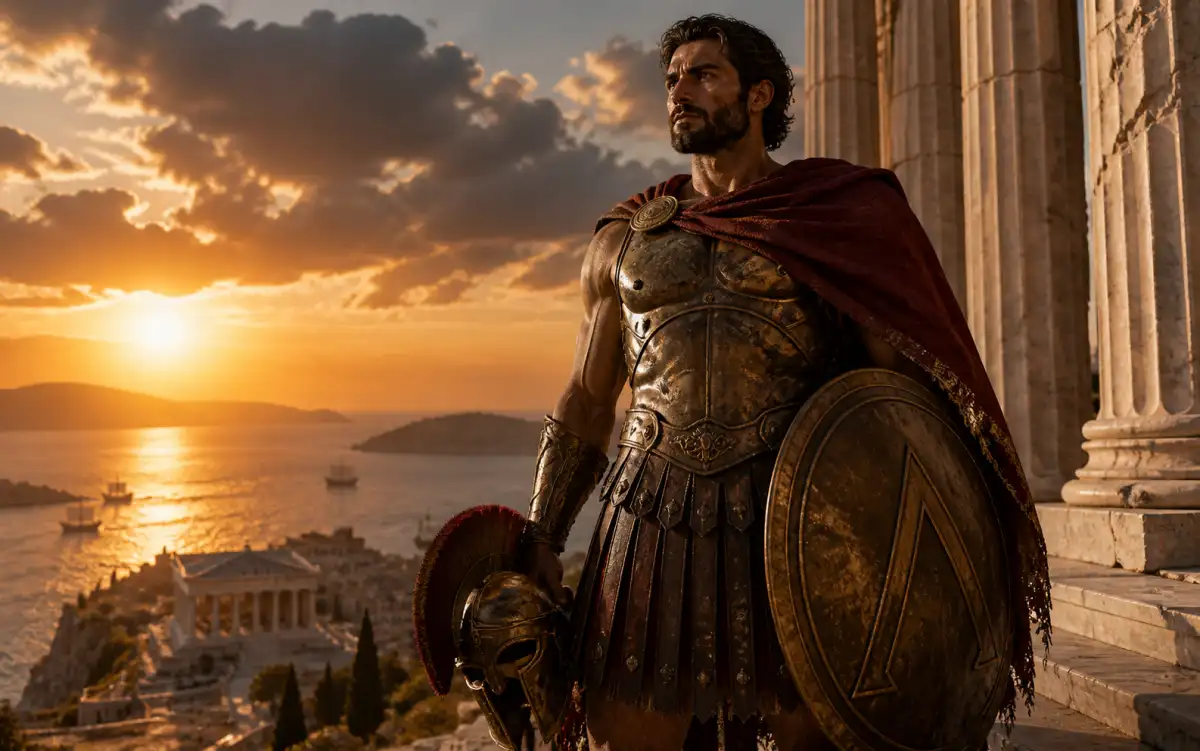
Male Greek names often focus on courage, victory, wisdom, honor, and divine favor. Names tied to strength were especially common in ancient Greece because parents believed names influenced destiny.
| Name | Pronunciation | Meaning |
|---|---|---|
| Theron | /THAIR-on/ | Hunter |
| Lysander | /ly-SAN-der/ | Liberator of Men |
| Evander | /eh-VAN-der/ | Good Man |
| Stavros | /STAV-ros/ | Cross Bearer |
| Nikephoros | /nee-KEH-for-os/ | Bringer of Victory |
| Dimitrios | /dee-MEE-tree-os/ | Devoted to Demeter |
| Achilleus | /ah-KIL-ee-us/ | Pain of the People |
| Spiros | /SPEE-ros/ | Spirit, Breath |
| Ptolemaios | /tol-eh-MY-os/ | Aggressive, Warlike |
| Kostas | /KOS-tas/ | Steadfast |
Names like Nikephoros (Bringer of Victory) and Lysander (Liberator of Men) tell you exactly what kind of character you're building before a single line of backstory is written. That's the power of Greek etymology — every name is a tiny story in itself.
Female Greek Names and Their Meanings
Greek female names often connect to beauty, intelligence, nature, radiance, and mythology. They work equally well for fantasy queens, modern protagonists, scholars, or myth-inspired characters.
| Name | Pronunciation | Meaning |
|---|---|---|
| Calliope | /kah-LY-oh-pee/ | Beautiful Voice |
| Eleni | /eh-LEH-nee/ | Shining Light |
| Thalassa | /thah-LAS-ah/ | The Sea |
| Dimitra | /dee-MEE-trah/ | Earth Mother |
| Kassandra | /kah-SAN-drah/ | She Who Entangles Men |
| Ariadne | /ar-ee-AD-nee/ | Most Holy |
| Fotini | /foh-tee-NEE/ | Light, Radiance |
| Penelope | /peh-NEL-oh-pee/ | Weaver |
| Stavroula | /stav-ROO-lah/ | Of the Cross |
| Melaina | /meh-LAY-nah/ | Dark, Black |
Calliope (Beautiful Voice) was the muse of epic poetry — a name that carries cultural weight beyond its literal meaning. Thalassa (The Sea) conjures an entire world the moment you hear it. Whether your character is a priestess, a warrior queen, or a modern Athenian, these names deliver depth instantly.
Gender-Neutral Greek Names
Some Greek names work naturally across genders, especially in modern usage. Gender-neutral Greek names are especially popular for fantasy characters, sci-fi settings, and modern storytelling where you want flexibility without sacrificing meaning.
| Name | Pronunciation | Meaning |
|---|---|---|
| Alexis | /ah-LEX-is/ | Defender |
| Chryse | /KREE-seh/ | Golden |
| Aris | /AH-ris/ | Excellence |
| Phaidra | /FAY-drah/ | Bright, Radiant |
| Nikita | /nee-KEE-tah/ | Unconquered |
| Kyrie | /KEE-ree-eh/ | Lord, Authority |
| Stelios | /STEL-ee-os/ | Pillar |
| Agape | /ah-GAH-peh/ | Unconditional Love |
| Kosmos | /KOZ-mos/ | Order, Universe |
| Zephyr | /ZEF-er/ | West Wind |
Names like Alexis (Defender) and Nikita (Unconquered) carry power without signaling a specific gender. Zephyr (West Wind) has become an increasingly popular modern unisex name while keeping its ancient Greek roots fully intact.
How to Pick the Right Greek Name
A Greek name generator gives you options — choosing the right one depends on your project. A few practical considerations help narrow it down.
Match the era. A name like Achilleus feels ancient and mythological. A name like Nikos feels modern and grounded. Make sure the name matches your setting.
Think about meaning. Greek names are unusually transparent compared to many naming traditions. A healer might fit Iason or Panakeia. A warrior might fit Andronikos or Nikephoros. The meaning quietly reinforces personality before the character even speaks. For punchy, quick-to-pronounce alternatives, our Slayer Name Generator works well alongside Greek picks.
Test the pronunciation. Some Greek names look intimidating but sound beautiful aloud — Persephone, Calliope, Ariadne. Others may be harder for readers or players to remember. If you're naming a D&D character or RPG hero, readability matters more than absolute historical accuracy.
Build around the name. The best Greek characters usually have layered identities. Helena is a name. Helena Petropoulos is grounded. Helena Petropoulos, Oracle of Rhodes is unforgettable. The name becomes much more memorable once titles, nicknames, or surnames are added.
Greek Names in Popular Media
Greek-inspired names are everywhere in games, movies, fantasy novels, and anime because they instantly feel legendary. Here are a few standout examples worth studying.
Percy Jackson mixes modern and mythological Greek naming styles — Percy (Perseus), Thalia, Nico, Zoe. The series keeps names approachable while still rooted in mythology, which is exactly the sweet spot for modern fantasy with Greek roots.
Assassin's Creed Odyssey uses historically authentic Greek names throughout — Kassandra, Alexios, Brasidas, Perikles. That authenticity helps the setting feel believable. If you're building a character for an ancient-world setting, drawing from classical Greek names is the way to go.
God of War uses names like Kratos, Athena, Ares, and Poseidon, which show how Greek words naturally carry dramatic weight in fantasy storytelling.
Dungeons & Dragons settings like Theros lean heavily on Hellenic naming traditions. Greek names work especially well for paladins, scholars, demigods, oracles, bards, and warrior-kings. That's one reason Greek-style fantasy naming remains so popular across RPG communities.