Explore now
Home
Vampire NamesKingdom NamesWitch NamesWarlock NamesDruid NamesMonster NamesPirate Ship NamesGang NamesGreek NamesFlower NamesLeprechaun NamesSuper Villain NamesMy Little Pony NamesHarry Potter Names
Tiefling NamesBard NamesHalf-Elf NamesBreton NamesNord NamesSlayer NamesD&D NamesCharacter NamesOC NamesFortnite NamesWCUE NamesStardew Farm NamesPlayStation Names
Anime NamesMHA Names
Alien Names
American NamesIrish NamesSilly NamesDrag NamesRapper NamesKpop Group Names
Playlist NamesDiscord Server NamesCursive Names

Tiefling Name Generator

Need a name for your Tiefling that actually sounds like it belongs in the Nine Hells? This Tiefling Name Generator gives you 150+ lore-friendly names — male, female, and neutral — complete with pronunciations and meanings. Just pick a category and hit generate.

What Exactly Is a Tiefling?

If you've played D&D for more than five minutes, you've probably seen one at the table — the character with curling horns, a tail that won't stay still, and an unsettling amount of charisma. That's a Tiefling.

Tieflings are one of the playable races in Dungeons & Dragons, and they've been around since 2nd Edition (though they really hit their stride in 4th and 5th Edition). They're not demons, and they're not devils — they're the descendants of humans who, at some point in their family tree, got a little too cozy with fiendish powers. Most of that traces back to Asmodeus, the Lord of the Nine Hells, thanks to a pact that cursed an entire bloodline.

What makes Tieflings interesting isn't the horns or the glowing eyes. It's the tension they carry. They look like something people should be afraid of, and plenty of NPCs treat them that way. But most Tieflings aren't evil — they're just stuck dealing with a heritage they didn't choose. Some lean into it. Some rebel against it. That conflict is exactly what makes them such compelling characters to play.

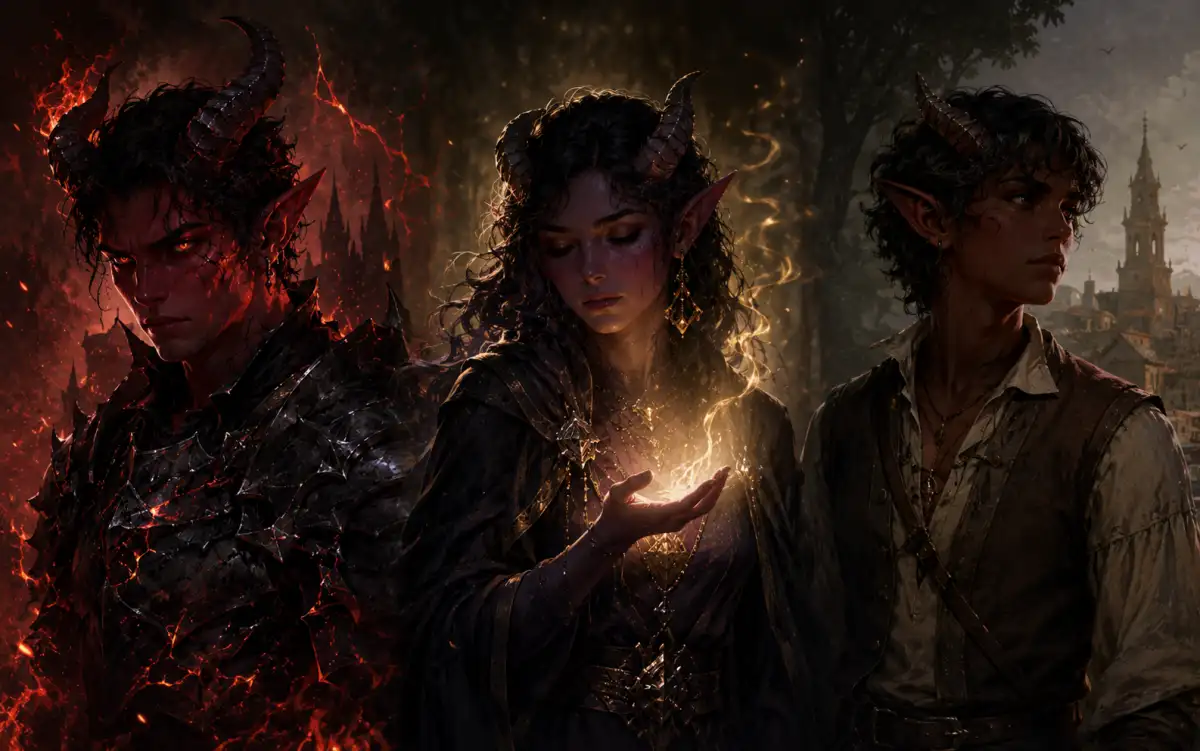
Physically, they tend to have skin tones ranging from deep reds and purples to more human-like shades with an otherworldly undertone. Solid-colored eyes (no visible pupils), sharp canines, and of course, the horns and tail. In Baldur's Gate 3, they're some of the most popular character picks for a reason — they just look cool. That's also why a good Tiefling name generator matters — the right name completes the character.

How Tiefling Names Actually Work in D&D

Tiefling naming conventions aren't random. There's a system to it, even if it's a flexible one.

When a Tiefling is born, they typically receive a name from their parents — one that reflects their infernal heritage. These names tend to pull from the Infernal language, the tongue of devils in D&D lore. Think harsh consonants mixed with unexpectedly melodic syllables. Names like Morthos, Criella, and Akmenos have that signature blend of menace and elegance.

But here's where it gets interesting. Not every Tiefling keeps the name they were given. Some choose a virtue name instead — a single word that represents a concept or ideal they want to embody. It might be something they aspire to, like Hope or Valor. Or it might be ironic, chosen out of spite or dark humor. A Tiefling named Mercy who shows absolutely none? That's peak D&D energy.

Most Tieflings don't use family surnames the way humans do. Their infernal bloodline makes family connections... complicated. Some use their parent's first name as a loose surname. Others just go by one name entirely. The flexibility here is actually a gift for players — you're not boxed in. Our Tiefling name generator above covers all three naming styles, so scroll back up and try it.

Types of Tiefling Names

Broadly, Tiefling names fall into three buckets:

Infernal names are the most traditional. They sound like they were pulled straight from a contract signed in the lower planes. Sharp, weighty, and hard to forget. These are names like Karnathos, Zarathys, and Balzareth — the kind that make an NPC pause before responding.

Virtue names are a uniquely Tiefling tradition. Unlike other D&D races, Tieflings sometimes abandon their given name and adopt a single concept as their identity. According to the Player's Handbook, these names represent "a concept they try to embody." Common virtue names include Carrion, Glory, Torment, and Creed. They can be positive or negative — it's entirely up to the character's story.

Hybrid or adapted names are what you get when a Tiefling grows up outside of traditional Tiefling society. Maybe they were raised by humans, or in a multicultural city like Waterdeep or Baldur's Gate. Their names might blend infernal sounds with human naming patterns — similar to how half-elf names blend elvish and human traditions — or they might just use a common name with no infernal flavor at all.

Male Tiefling Names and Their Meanings

Male Tiefling names tend to hit hard. Lots of guttural sounds, strong endings, and a general vibe of "don't mess with me." These work great for warlocks, fighters, paladins — really any class where the character has something to prove.

NamePronunciationMeaning
Vexarth/VEX-arth/Shadow of Fire
Karnathos/kar-NAH-thos/Warrior of the Flame
Morthrex/MOR-threx/Bringer of Dusk
Draknis/DRAK-nis/Serpent's Heir
Balzareth/BAL-zah-reth/Keeper of the Pit
Grimvael/GRIM-vale/Iron Dusk
Syndrak/SIN-drak/Chain Breaker
Azmodran/az-MOH-dran/Fallen Star
Phyrax/FY-rax/Flame Devourer
Velkorith/vel-KOR-ith/Shadow Prince

Names like Syndrak (Chain Breaker) or Azmodran (Fallen Star) already tell a story before the campaign even starts. That's what you want from a Tiefling name generator — a name that gives your DM something to work with.

Female Tiefling Names and Their Meanings

Female Tiefling names often have a more flowing quality, but don't mistake that for softness. There's still an edge to them — an undercurrent of fire and shadow that keeps things distinctly Tiefling.

NamePronunciationMeaning
Zarathys/ZAR-ah-this/Fiery Strength
Belzara/bel-ZAR-ah/Whisper of the Inferno
Nyxaris/nix-AR-is/Daughter of Night
Morrigan/MOR-ih-gan/Phantom Queen
Seraphyx/SAIR-ah-fix/Burning Wing
Crysthala/cris-THAH-lah/Frozen Flame
Thessaly/THES-ah-lee/Witch of the Vale
Luxara/lux-AR-ah/Light in Darkness
Onyxia/oh-NIX-ee-ah/Jewel of the Abyss
Selvithra/sel-VITH-rah/Silent Fury

Crysthala (Frozen Flame) is one of those names that practically writes a backstory on its own. Same with Luxara — Light in Darkness. If your character's story involves inner conflict between their fiendish nature and something gentler, names like these sell that immediately.

Gender-Neutral & Virtue Tiefling Names

Not every character fits neatly into a binary, and Tiefling society — such as it is — tends to care a lot less about gender norms than most D&D cultures. Neutral names work for any character, and virtue names are genderless by definition.

NamePronunciationMeaning
Thyrix/THY-rix/Wanderer of Fire
Zerith/ZAIR-ith/Heart of the Inferno
Ashken/ASH-ken/Born of Cinder
Pyren/PY-ren/Living Flame
Kaelix/KAY-lix/Shifting Shadow
Ravyn/RAV-in/Shadow Feather
Phyren/FY-ren/Phoenix Reborn
Zaryx/ZAR-ix/Spark of Defiance
Hexyn/HEX-in/Touched by Fate
Brimwen/BRIM-wen/Edge of Dawn

Virtue names — the ones that are just a concept — are worth considering too. In the Player's Handbook, the suggested virtue names include things like Art, Carrion, Creed, Despair, Fear, Glory, Hope, Music, Open, Poetry, Quest, Random, Sorrow, and Torment. You can use any abstract concept, really. A Tiefling rogue named Silence? A paladin named Reckoning? Both work perfectly.
How to Pick the Right Tiefling Name for Your Character

A Tiefling name generator can give you plenty of options, but how do you narrow it down? There's no wrong answer, but some approaches work better than others. A few things worth thinking about:

Match the name to the backstory. If your Tiefling was raised among humans and actively rejects their infernal heritage, a soft or human-sounding name makes sense. If they embrace their nature, something heavier and more infernal fits better. The name should feel like a natural extension of who they are.

Think about how it sounds at the table. You're going to say this name out loud, probably hundreds of times over a campaign. If it's got six syllables and three apostrophes, everyone (including you) is going to shorten it to something else within two sessions. Pick something your group can actually say.

Consider what it means. A name with meaning gives your DM hooks to work with. Damakhor means "Ironblood" — that's a whole plot thread waiting to happen. Embris means "Spark of Life" — maybe your character came back from near death. Meaning adds depth without requiring a three-page backstory.

Don't overthink it. Seriously. Some of the most memorable D&D characters have names that were picked in thirty seconds because they just sounded right. Trust your instincts. If a name feels like your character, it probably is.

Tiefling Names in Baldur's Gate 3

If you found this page because you're making a Tiefling in BG3, you're in good company. Tieflings are one of the most popular race picks in the game, partly because of how well Larian Studios brought them to life visually, and partly because of characters like Karlach — who might be the most beloved companion in recent RPG history.

Baldur's Gate 3 follows D&D 5e naming conventions pretty closely. The game's notable Tiefling NPCs include Zevlor, Lakrissa, Alfira (a Tiefling Bard — if you're building one, check out our Bard Name Generator), and of course Karlach herself. If you look at those names, they follow the same patterns — infernal-sounding, melodic but with bite, and easy to say out loud during gameplay.

Any name from our Tiefling name generator works for BG3. The game doesn't restrict character names, so you're free to use whatever fits your vision. If you're exploring other character concepts, our Anime Name Generator and other tools offer even more creative options. Just keep in mind that BG3 companions will say your character's name in dialogue if it matches a preset — otherwise they'll use "Tav" or your custom name silently.

Frequently Asked Questions

As many as you want. There's no limit — this Tiefling name generator lets you click generate as many times as you need. It pulls from a pool of 150+ names and shuffles them randomly each time.
Yes. The names follow the Infernal naming conventions described in the Player's Handbook and other official D&D sourcebooks. They're designed to sound authentic to the setting.
Absolutely. BG3 uses D&D 5e rules and naming conventions, so any name from this generator will fit right in. There are no naming restrictions in character creation.
Virtue names are a Tiefling-specific tradition where a character adopts a single concept as their name — like Hope, Torment, Creed, or Glory. They represent an ideal the Tiefling wants to embody or reject.
Typically no. Most Tieflings go by a single name. Some use a parent's first name loosely as a surname, and others adopt a clan or house name if their backstory calls for it. There's no strict convention.
Completely free. No sign-up, no subscription, no hidden costs. Just open the page and start generating names.
Copied!